
Tree Removal in Boise: Why Late Fall and Winter Can Be the Smart Time to Act
Maybe it is the big silver maple that drops a limb every spring. Maybe it is a dying spruce leaning a little closer to the garage each year, or a cottonwood whose roots are lifting the driveway. You have been putting off the decision, and now the leaves are coming down and winter is on the way. Here is something many homeowners do not realize: tree removal in Boise is often easier, cleaner, and less disruptive in late fall and winter than in the middle of summer. The canopy is bare, the ground firms up, and a hazardous tree can come down on your schedule instead of the next storm’s. In this guide, we will walk through why the dormant season works so well for removals, how to decide whether a tree should come down or be saved, what to know about street trees in Boise, what happens on removal day, and what affects the cost. Our goal is simple: help you make an informed, safety first decision about the trees on your property.
Why the Dormant Season Is a Good Time for Tree Removal in Boise
Trees can be removed any time of year when safety demands it. But late fall through winter offers some real advantages for planned work.
Better Visibility and Lighter Loads
Once the leaves drop, our arborists can see the full structure of the tree, including cracks, decay, and weak unions that summer foliage hides. A bare tree is also lighter. That means each section is easier to control as it is lowered, which reduces risk to your home, fences, and landscaping.
Less Impact on Your Yard
Cooler temperatures and firmer ground mean heavy equipment is less likely to rut the lawn or compact the soil. Dormant lawns, perennials, and shrubs also recover better from foot traffic than they do during the growing season. Less mess. Less repair. Less stress on the rest of your landscape.
Beat the Storm to It
A hazardous tree does not get safer with time. Removing it in the fall, before wet snow and winter wind arrive, means the job happens in calm, controlled conditions instead of as an emergency call after a limb has already come through the roof.
Should You Remove the Tree or Try to Save It?
Removal is never our first answer. A mature canopy is one of the most valuable assets on your property, and many trees can be preserved with the right care.
When a Tree Can Often Be Saved
Trees with a few dead limbs, minor storm damage, or a crowded canopy can usually be corrected with structural pruning. Some weak unions can be supported with cabling or bracing. If the trunk and roots are sound, there is often a path to keep the tree healthy and safe for years.
When Removal Is the Right Call
Removal becomes the responsible choice when a tree has extensive decay in the trunk or root flare, a severe lean with root lifting, major splits that cannot be supported, or it is dead or dying. Trees growing into power lines, undermining foundations, or crowding out healthier trees can also be candidates.
How Our Arborists Help You Decide
Our ISA Certified Arborists start with a hazard assessment, not a sales pitch. We look at the tree’s structure, health, and what it could hit if it failed. Then we explain your options plainly and help you decide when a tree can be saved and when it is time for a careful, low impact removal.
Do You Need Permission to Remove a Street Tree in Boise?
This is one of the most common questions we hear from Boise homeowners, and the answer depends on where the tree is growing.
Trees in the Public Right of Way
Many trees along Boise streets, including those in planting strips between the sidewalk and the curb, sit in the public right of way. According to the City of Boise’s guidance on public tree removal, the city is responsible for removing dead, diseased, or hazardous trees in these areas. Homeowners cannot remove them on their own. If you are concerned about a street tree, Boise Community Forestry will inspect it at no charge and decide whether removal or pruning is the right step.
Trees on Private Property
Trees fully on your own property are generally your responsibility to maintain and, when needed, remove. If you are unsure where your property line or the right of way begins, it is worth confirming before any work is scheduled. We are happy to help you sort that out during your consultation.
What Happens on Tree Removal Day?
Knowing what to expect makes the process far less stressful. Every removal gets its own plan, but most follow the same basic steps.
Planning and Site Protection
Before the first cut, our crew walks the site, identifies targets such as your roof, fences, and utility lines, and sets up a safe work zone. We plan exactly where each section will be lowered and how equipment will move across your property to minimize impact.
Controlled Takedown
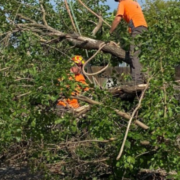
Most trees are taken down in sections, starting from the top, with ropes and rigging used to lower heavy pieces under control. For large trees, tight backyards, or trees leaning over a house, we use our own crane, rated at 30 tons and able to reach 95 feet plus a jib extension of 32 feet. Our crane removal services let us lift sections up and away instead of dropping them near your home.
Cleanup and Site Restoration
When the tree is down, we clean up branches and debris and leave the site tidy. Wood can be hauled away for recycling or cut into manageable pieces if you want to keep it for firewood. Stump grinding is available as an added option if you want the area ready for new grass or a replacement tree.
Thinking About What Comes Next
Losing a large tree changes the look and feel of a yard. Many homeowners choose to plant a replacement, ideally a species better suited to the spot and to our high desert climate. If that is your plan, let us know during the consultation. Grinding the stump, clearing the root debris, and choosing a new location away from the old root zone all help a new tree get off to a stronger start.
How Much Does Tree Removal in Boise Cost?
There is no single price for tree removal, because no two trees or properties are the same. What we can do is explain exactly what drives the number.
The Main Cost Factors
Price depends on the tree’s height and trunk size, its condition, how close it is to your home or power lines, and how easy the site is to access. A healthy tree in an open yard is a much simpler job than a decayed tree leaning over a roof in a fenced backyard. Crane work, stump grinding, and wood hauling also affect the total.
Written Estimates, No Surprises
Every job starts with a free consultation and a written estimate. We explain what is included, what is optional, and why we recommend the approach we do. No pressure. No hidden fees. No surprises on the final bill. For bigger jobs, you can learn more on our big tree removal page for Boise.
Why Boise Homeowners Choose Arbor Safe
Arbor Safe has served Nampa, Boise, Meridian, Eagle, Caldwell, Kuna, and the greater Treasure Valley since 1997. Our team includes ISA Certified Arborists and Certified Tree Workers, we follow TCIA safety standards, and we are licensed and bonded. You can learn more about the full range of services we offer on the Arbor Safe Tree Service homepage. When a tree comes down, it comes down on a plan, with every cut intentional and your property protected from start to finish.
Plan Your Removal Before Winter Arrives
Late fall and winter are an excellent time to handle tree removal in Boise. The canopy is bare, the ground is firmer, and the work can happen on a calm day instead of in the middle of a storm. Start with an honest assessment of whether the tree can be saved, check whether it sits in the public right of way, and make sure you understand the plan and the price before any work begins.
If there is a tree on your property that has been worrying you, now is the time to get answers. Request a free consultation with Arbor Safe Tree Service or call 208-465-9479, and our certified team will help you make the safest decision for your home and your landscape.