
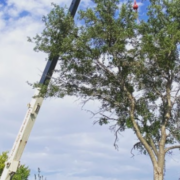
Winter Storm Tree Damage in Nampa: Which Trees Are Most at Risk This Season
It happens fast in the Treasure Valley. One week you are raking leaves in shirt sleeves. The next, a wet October or November snow rolls in while half the leaves are still on the trees, and by morning the street is littered with split limbs, a branch is resting on your roof, and the power is out on the block. Winter storm tree damage is not random. Some trees break far more often than others, and the warning signs are usually visible weeks before the first flake falls. This fall is your window to find them. In this guide, we will explain why early snow and winter wind hit Treasure Valley trees so hard, which common species carry the most risk, the specific defects our ISA Certified Arborists look for, and what you can do now to protect your home. We will also cover what to do safely if a storm does bring a limb down. Every tree is different. The goal here is to help you make an informed, safety first decision before the weather makes it for you.
Why Winter Storm Tree Damage Hits the Treasure Valley So Hard
Our climate sets trees up for a tough transition. Long, hot, dry summers are followed by a fall that can swing from 70 degrees to a hard freeze in a matter of days.
Early Snow Lands on Full Canopies
Many deciduous trees here hold their leaves well into October and sometimes November. When wet snow arrives before leaf drop, every leaf becomes a platform for extra weight. A canopy that would shed a dry winter snow can suddenly carry many times its normal load, and weak limbs give way.
Wind Finds Every Weak Point
Idaho windstorms do not need snow to cause trouble. Strong gusts across open valley ground put heavy, repeated stress on branch unions and root plates. A limb with a hidden crack may survive a dozen calm days and fail in the first real blow.
Summer Stress Carries Into Winter
Months of heat and irregular irrigation can leave trees drought stressed going into fall. Stressed trees are more likely to have dieback, decay, and brittle wood. That is exactly the kind of weakness a winter storm exposes.
Which Trees Are Most at Risk From Winter Storm Tree Damage?
Species matters. Some trees are simply built with softer wood or weaker branch attachments, and they tend to be the first to fail when snow and wind arrive.
Soft, Fast Growing Species
The Treasure Valley Tree Selection Guide published by the City of Boise lists several common trees that should not be planted in public rights of way, largely because of structural problems. Cottonwoods, poplars, willows, boxelder, and silver maple are noted for soft wood that is prone to decay, and silver maple is also flagged for poor branch structure. Black locust is described as having brittle wood, and tree of heaven is noted for weak branch attachments.
What That Means for Your Yard
None of this means every one of these trees is a hazard. Plenty of healthy, well pruned silver maples and cottonwoods stand for decades. But if one of these species is growing over your house, driveway, or play area, it deserves a closer look before winter than a slow growing, strong wooded tree would.
Large, Mature Trees Near Structures
Size changes the stakes. A limb that is harmless on a young tree can weigh hundreds of pounds on a mature one. The older and larger the tree, and the closer it sits to your home, the more important it is to know its condition.
What Warning Signs Should You Look for Before Winter?
You can spot many problems from the ground. Walk your property on a clear day, look up through the canopy, and take note of anything on this list.
Dead Wood and Hanging Limbs
Dead branches are dry, brittle, and among the first to fail under snow. In fall, look for limbs that dropped their leaves early or never leafed out this year. Broken limbs caught in the canopy, often called widow makers, can fall without warning and should be removed by a trained crew.
Cracks, Weak Unions, and Codominant Stems
Look where large limbs meet the trunk. Deep cracks, open seams, or two stems of similar size growing in a tight V are common failure points. These unions often have bark pinched between them, which weakens the connection and lets snow and wind pry them apart.
Decay, Fungus, and Root Problems
Mushrooms or conks growing on the trunk or roots, soft or hollow wood, and missing bark are all signs of decay you may not see from outside. A tree that has started leaning recently, or soil that is heaving on one side, points to a root problem that deserves attention now.
How Can You Protect Your Trees Before the First Storm?
A little work in the fall can prevent a lot of damage in the winter. The right approach depends on the tree, its condition, and what is underneath it.
Structural Pruning and Canopy Thinning
Removing dead wood, reducing overextended limbs, and correcting weak unions lowers the load a tree has to carry. Selective thinning also lets wind pass through the canopy instead of catching it like a sail. Every cut should be intentional. Topping or heavy, indiscriminate cutting creates weak regrowth that breaks even more easily later.
Cabling, Bracing, or Removal
In some cases, a tree with a weak union can be supported and preserved. In others, the defect is too severe, and removal is the only way to protect your home and your neighbors. Our certified arborists will tell you plainly which situation you are in and why.
Knock Snow Off Gently, and Only From the Ground
If an early snow starts piling up on a small tree or shrub you can reach safely from the ground, a broom pushed gently upward under the branches can relieve some of the weight. Never shake or strike frozen limbs, which can snap them, and never stand under a loaded branch. For anything above head height, leave it alone and let a professional assess it once the storm passes.
Know Your Limits
Any work near power lines, on large limbs, or high in the canopy is dangerous. It is not a ladder and chainsaw job. The safest move is a professional hazard assessment before you or anyone else starts cutting.
What Should You Do If a Storm Brings Down a Limb?
Even with good preparation, storms can surprise you. How you respond in the first few hours matters for your safety and your property.
Stay Clear and Call the Right People
Keep everyone away from downed limbs, especially anything touching or near power lines. Assume any line is live and call your utility right away. If a tree or large limb is on your house or blocking access, move to a safe area and call for emergency help.
Document and Do Not Rush
Take photos of the damage for your insurance company before anything is moved. Resist the urge to cut hanging or tangled limbs yourself. Branches under tension can spring back with enough force to cause serious injury.
Get Professional Emergency Help
Arbor Safe provides 24/7 emergency tree service across Nampa, Boise, Meridian, Caldwell, Eagle, Kuna, and the greater Treasure Valley. Our team can stabilize the situation, remove dangerous limbs, and clean up the site without adding further damage to your home.
Why Treasure Valley Homeowners Trust Arbor Safe
Since 1997, our team has completed thousands of jobs across the valley. Our crew includes ISA Certified Arborists and Certified Tree Workers, we follow TCIA safety standards, and we are licensed and bonded. We start with a free consultation, give you a written estimate with no surprises, and help you decide when a tree can be saved and when it is time for a careful, low impact removal. You can see more about our full range of services on the Arbor Safe Tree Service homepage.
Get Ahead of Winter Storm Season
Winter storm tree damage in the Treasure Valley tends to follow a pattern. Early wet snow on leafy canopies, soft wooded species, and hidden defects like cracks, weak unions, and decay are the usual culprits. Fall is the best time to find and fix them, while the weather is still calm and your options are wide open. A professional assessment now can mean the difference between a planned pruning and an emergency call at 2 a.m.
Do not wait for the next Idaho windstorm to find out which of your trees is the weak link. Schedule a free consultation with Arbor Safe Tree Service or call 208-465-9479, and let our certified team help you protect your home, your trees, and your neighbors this winter.